
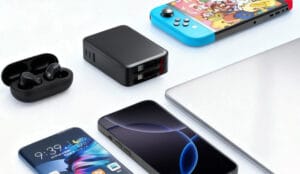
Charging Handshake: How PD and QC “Talk” to Your Phone
Introduction: The Silent Conversation You Never Knew Existed Every time you plug your smartphone, tablet, or laptop into a charger, a complex digital negotiation takes place in milliseconds. This is called the “handshake.” Without this handshake, your expensive 100W GaN charger is nothing more than a glorified 5W brick. The handshake determines how much voltage and current your device receives, dictating whether you wait 30 minutes for a full charge or three hours. In the world of fast charging, there are two dominant “languages” for this handshake: USB Power Delivery (PD) and Qualcomm Quick Charge (QC) . While both achieve the same goal—faster charging—their handshake processes are entirely different. One uses physical voltage pulses on data wires; the other uses sophisticated digital data packets on a dedicated pin. This article dissects the anatomy of both handshakes, explains why they fail, and reveals how the new PPS standard is rewriting the rules of communication. What Exactly is a Charging “Handshake”? In

Recent Comments