hello@lideraccessories.com

Email us

+86 137 10 394959

Whatsapp

Mon - Sat: 9:30 - 21:30

6 Days a week

Press & News

Welcome to the official Press & News hub for Lider Accessories. This is your central destination for the latest updates on our journey to redefine style and functionality.

Here, you will find all our official press & news announcements, including product launches, media features, and community initiatives. We believe in transparency and keeping our community informed. Whether you are a journalist looking for our latest media kit, a partner checking for company updates, or a loyal customer wanting to stay in the loop, this page compiles all the essential stories about our brand’s growth.

From exclusive interviews with our designers to coverage of our latest collections in top lifestyle publications, we curate it all here for easy access. We are constantly evolving, and this section serves as the official timeline of our progress and milestones.

We invite you to explore the articles below and see why Lider Accessories is becoming a leader in the industry. For specific media inquiries or high-resolution assets, please don’t hesitate to contact our team directly.

Phone Chargers Wholesale

When Should You Replace Your Phone Charger? 7 Warning Signs You Must Know

Your phone charger is one of those everyday gadgets you never think about – until it stops working. But waiting until it dies completely could be a costly mistake. A failing charger doesn’t just charge slowly; it can damage your phone’s battery, cause data loss, or even create a fire hazard.So, when should you replace your phone charger? In this guide, we’ll cover seven clear warning signs, safety concerns, and how to choose a reliable replacement. Why You Shouldn’t Ignore a Faulty Charger Most people keep using the same charger for years, long after its performance has dropped. But a damaged or aging charger can: Replacing a charger costs $10–30. Replacing a phone? Hundreds. The math is simple. 7 Signs It’s Time to Replace Your Phone Charger 1. Your Phone Charges Very Slowly (Even on Fast Charger) If your phone used to go from 0% to 50% in 30 minutes but now takes two hours on the same charger, something is wrong. Try a different charger first. If the problem disappears, your original charger is failing. Why this happens: Internal wires or capacitors degrade over time, reducing power output. 2. The Charger Gets Unusually Hot A slight warmth during fast charging is normal. But if your charger brick or cable becomes too hot to touch or smells like burning plastic, stop using it immediately. Overheating chargers are a serious fire risk. Replace them right away. 3. Physical Damage – Frayed Cables, Bent Pins, or Loose Connections Inspect your charger regularly: Any physical damage means it’s

More Details»
Super fast home chargers wholesale

Power Management IC: The Hidden Brain of Your Phone That Controls Charging, Heat, and Safety

Power Management IC – Ever wondered why your phone charges slower when it’s hot, or why the back feels warm when you’re watching a video while plugged in? And what about those rare but terrifying news stories of phones catching fire? The answers lie inside a tiny, unsung hero: the Power Management Integrated Circuit, or PMIC. About the size of a fingernail, your phone’s PMIC is the nerve center for all things energy-related. It’s not the battery itself; it’s the intelligent traffic controller that decides where every electron should go. Understanding this chip explains almost every strange charging behavior you experience daily. 1. Why Your Phone Doesn’t Charge Linearly (The 0-100% Mystery) You’ve noticed it: your phone zooms from 0% to 50% in 20 minutes, but the last 20% takes an hour. This isn’t a conspiracy—it’s your PMIC protecting your battery’s lifespan. Real-life scenario: You plug in at 5% before a meeting. The Power Management IC pushes a fast “top-up” charge for 10 minutes, giving you 40% battery. An hour later, it’s still slowly climbing to 100%. That’s not a bug; it’s smart chemistry in action. 2. The Heat Question: Why Does Charging Make Your Phone Feel Like a Hand Warmer? Heat during charging is normal—to a point. Your PMIC (Power Management IC ) and charging circuitry aren’t 100% efficient. When you convert 18-watt, 9-volt fast-charging energy down to the 4.2-volt energy your battery needs, waste heat is inevitable. But three factors dictate how hot your phone gets: When heat becomes a problem: Your phone

More Details»
240W PD Charger Cable Wholesale

USB Charging Cable vs. USB Data Cable: What’s the Difference and Why It Matters

At first glance, USB charging cable and USB data cable look the same. They all have the familiar rectangular (USB-A) or oval (USB-C) connectors, and they all seem to fit into your phone, laptop, or power bank. However, not all USB cables are created equal. In fact, using the wrong cable for the wrong job can lead to painfully slow charging speeds, failed file transfers, or even security risks. The distinction between a USB charging cable and a USB data cable is one of the most misunderstood aspects of modern technology. While a charging cable is designed solely to deliver power, a data cable is built to handle both electricity and information. As a USB cable manufacturer in China, we will explain the technical differences, how to identify which cable you have, and why you need both types in your home. The Core Technical Difference: Wires Inside To understand the difference, you have to look inside the plastic casing of the cable. A standard USB 2.0 cable contains four copper wires inside the insulation: USB Charging Cable – the Charging-Only Cable A dedicated USB charging cable typically only contains the Power and Ground wires. The manufacturer omits the D+ and D- wires to save on production costs. Without these data wires, the cable is physically incapable of transferring files, photos, or music between a phone and a computer. USB Data Cable – the Data Cable A USB data cable (often called a “sync cable”) contains all four wires: Power, Ground, D+, and D-. This allows the cable to

More Details»
Custom USB C Cables Wholesale

The iPhone User’s 2026 Charging Guide: How to Choose the Perfect Fast Charger and Cable

To achieve the fastest charging speeds for your iPhone in 2026, you need a USB-C Power Delivery (PD) charger rated at 40W or higher and a high-quality USB-C to USB-C cable. The latest iPhone 17 models support 40W fast charging, allowing you to reach a 50% charge in around 20 minutes, significantly faster than older 20W chargers. The charging landscape has evolved rapidly, moving beyond the simple plug-and-play of the past. This guide cuts through the jargon of Gallium Nitride (GaN), PD 3.1, and Qi2 to provide you with a clear, actionable strategy for selecting a charging setup that is fast, safe, and future-proof for your iPhone and other devices. Understanding Your iPhone’s Charging Capability The first step is knowing what your specific iPhone model can handle. Apple has increased supported charging speeds over the years. Here’s a quick reference guide: iPhone Model Series Charging Port Max Wired Fast Charge Support Recommended Charger Minimum Required Cable Type iPhone 17 (All Models) USB-C 40W (PD 3.1) 40W USB-C PD Charger USB-C to USB-C iPhone 15 & 16 Series USB-C 20W+ (Supports faster charging) 20W USB-C PD Charger USB-C to USB-C (included) iPhone 14 & Earlier Lightning 20W+ 20W USB-C PD Charger USB-C to Lightning iPhone 8 to iPhone 13 Lightning 18W+ 18/20W USB-C PD Charger USB-C to Lightning Key Takeaway: For the fastest possible charge with any iPhone from the last 5 years, you must use a USB-C Power Delivery (PD) charger. The cable must match your phone’s port: USB-C to USB-C for iPhone 15 and later, or USB-C

More Details»
2IN1 GaN travel Charger

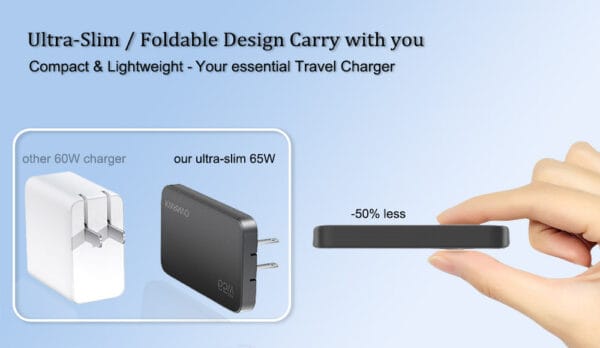
Specific Questions for USB GaN Chargers

What is GaN, and why is it better than a regular charger? GaN is a new semiconductor material that is more efficient than traditional silicon. Benefits include: Smaller Size & Lighter Weight: A 65W GaN charger can be half the size of an old 65W silicon charger. Cooler Operation: Generates less wasted heat. Higher Efficiency: Often leads to better power density and can support more advanced features in a compact form. Is a GaN charger worth the extra cost? Yes, for most people seeking portability. If you value a smaller, lighter charger for your bag, travel, or desk, GaN is a significant upgrade. If you just need a cheap, basic charger to leave plugged in at home, a standard charger may suffice. Do GaN chargers charge faster? Not directly. The speed is determined by the wattage and protocols, not the GaN material itself. However, because GaN allows manufacturers to pack higher wattage into smaller bricks (e.g., a tiny 140W charger), you are more likely to buy a powerful, fast-charging charger in a portable size. Does my charging cable matter? The phone charging cable play very important role in charging. It connects phone / tablet / laptop and the GaN charger. For example, we use the 100W GaN charger to charge 65W Macbook Pro with a max charging cable of 30W USB cable. The power Watts is only 30W. It is the lowest part that defines the charging speed.  Why I cannot use GaN chargers for my home gadgets, such as electronic tooth brush? Using USB fast chargers

More Details»
Tempered Glass Screen Protector

Screen Protector Terms and Words from a Manufacturer

In the world of mobile accessories, a screen protector is no longer just a simple piece of plastic. It is a sophisticated piece of engineering designed to preserve the clarity, responsiveness, and structural integrity of your device’s most important asset: the display. With the rise of foldable phones, curved edge displays, and advanced biometric security, the terminology surrounding screen protectors has become increasingly complex. If you have ever been confused by terms like “high-aluminum,” “silk-screen printing,” or “anti-static coatings,” you are not alone. As a screen protector manufacturer in China, we will break down every modern screen protector specification—from the shape of the glass to the chemical composition—to help you understand exactly what you are buying and why it matters. 1. The Evolution of Form Factors O-Shape and Octagonal Designs Gone are the days when all screen protectors were simple rectangles. Modern protectors often feature unique geometries to accommodate the specific design languages of smartphones. Full-Screen Silk-Screen When you see a protector labeled “Full-Screen Silk-Screen,” it refers to the border around the edge of the glass. 2. Material Science: Aluminum Content and Hardness The quality of tempered glass is determined by its manufacturing process and material composition. The term “aluminum” in this context refers to aluminosilicate glass, a type of glass strengthened by ion exchange. High-Aluminum vs. Medium-Aluminum The “White Sheet” (白片) Standard In manufacturing, a “White Sheet” (Clear) protector refers to a unit without a colored border. These are typically made from higher-grade raw glass because there is no silk-printed border to hide impurities

More Details»
Recent Comments