
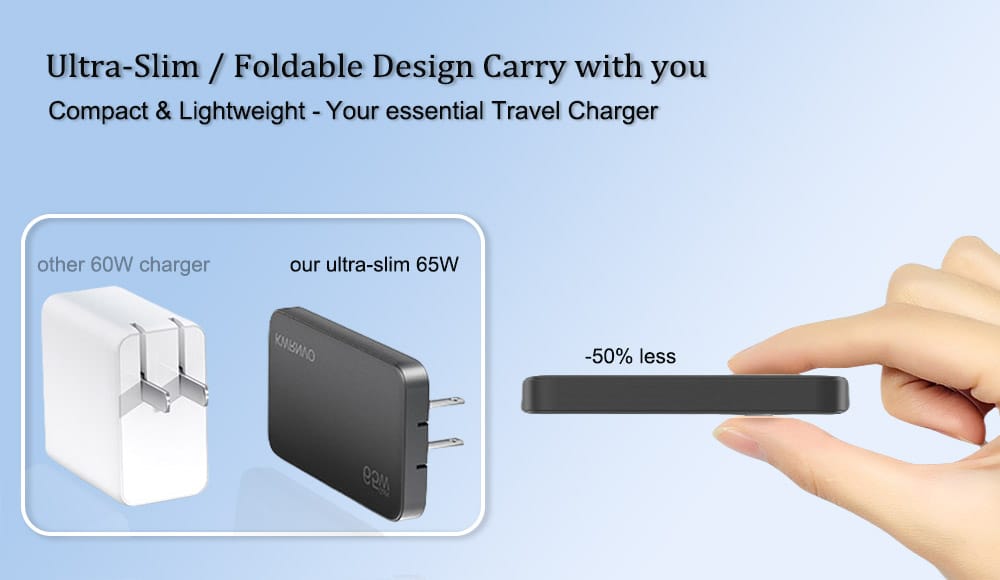
We interact with it every single day. It sits forgotten next to our bed, lives in the bottom of our work bag, and gets frantically plugged into the wall when the dreaded 10% battery warning pops up. But have you ever actually looked at your phone charger?
Pick it up and flip it over. Unless you are using a completely generic brick, you will see a dense cluster of tiny letters, numbers, and symbols that look like they were designed to confuse a rocket scientist. While most of us ignore this technical graffiti, those phone charger symbols and words are actually the blueprint of its soul. They tell you everything from how fast it will charge and whether it will blow up on vacation, to when you should throw it away and which secret languages (fast charging protocols) it speaks.
This guide will decode every mysterious glyph so you can stop playing guessing games with your electronics.
Chapter 1: The Basics – Voltage, Current, and the Power Formula
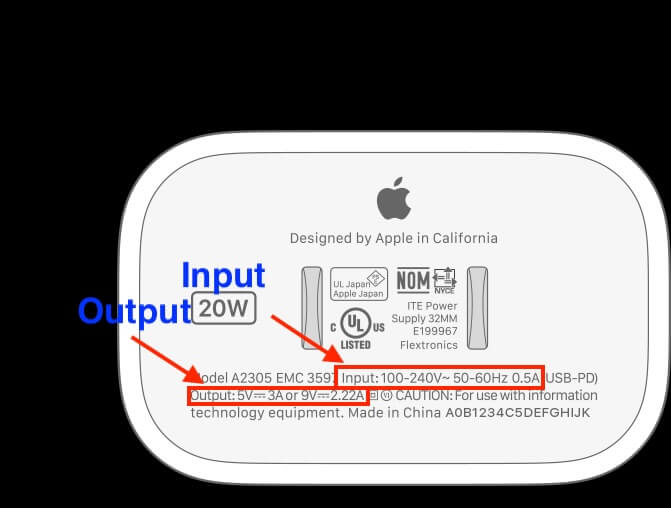
Before we dive into the strange symbols, we must start with the least sexy but most important part: the actual words Input and Output.
Most chargers will have two distinct sections labeled accordingly.
- Input: This tells the charger what it can safely eat from your wall. A typical label reads Input: 100-240V ~ 50/60Hz.
- Output: This is the most critical part. It tells the charger what it will actually deliver to your phone.
- Look for the straight line over a dotted line (⎓). This represents Direct Current (DC), the stable power your phone battery actually needs.
Take a look at the V and A numbers. A 5V/1A travel adapters (5 Watts) deliver trickle charging, which is very slow. A modern 20V/5A (100 Watts) charger is capable of fast charging or ultra-fast charging.
Chapter 2: The Secret Handshakes of Fast Charging Protocols
This is the wild west of charging. Just because the plug fits, does not mean you are getting maximum speed. For a phone to fast charge, the charger and the phone must agree on a charging protocol. Here are the symbols to look for if you want that “Super Fast Charging” notification to pop up.
- Qualcomm Quick Charge: If you see a circle containing a lightning bolt with a small superscript number (like 3.0, 4.0, or 5.0) next to it, this charger speaks Qualcomm Quick Charge. This is standard on many Android devices. The higher the number, the faster the speed.
- USB Power Delivery (PD): This is the universal standard, especially for USB-C. If you see a tiny “PD” logo or the label mentions “PPS” (Programmable Power Supply), you are dealing with USB PD. This is the best standard to look for because it works with iPhones (15 and up), Android phones, Nintendo Switch consoles, and even laptops.
- VOOC / SuperVOOC: While increasingly rare on generic blocks, if you have a charger from a specific brand like OPPO or OnePlus, you will see this. These are proprietary low-voltage, high-current systems that require specific cables to work.
Chapter 3: Decoding the Safety Certification Marks
These are the tiny logos that look like official stamps. They are your assurance that the charger won’t burn your house down.
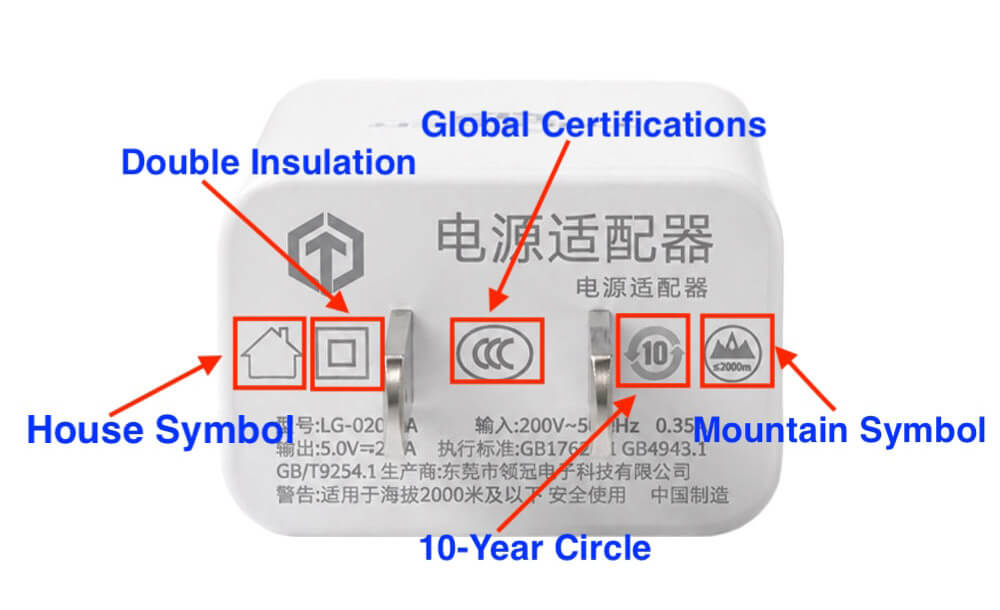
- The Square within a Square (Double Insulation / Class II): Look for a shape that is essentially a square inside a square. This is a Class II symbol. It means the charger has two layers of insulation, so it does not need a grounding prong on the plug. It is very safe for basic home outlets.
- The House Symbol: This tiny silhouette of a house means Indoor Use Only. Never take this charger outside in the rain or humidity; the unprotected components could short out.
- Global Certifications: You may see letters like CCC, CE, UL, or FCC on your charger.
- CCC indicates certification for the Chinese market.
- CE allows the charger to be sold in the European Union.
- UL is a rigorous safety standard recognized in North America.
- FCC indicates the charger will not interfere with your radio or TV reception.
Other variations like ETL, SAA, or PSE are simply regional equivalents for markets such as Australia or Japan.

Chapter 4: Environmental and Usage Limit Icons
There are three specific symbols that act as guardians or a “best by” date for your hardware.
- The Garbage Can with the X: This is known as the WEEE symbol. It simply means: Do not throw this in the regular trash. This charger contains electronic waste that must be recycled properly to protect the environment.
- The 10-Year Circle: You will sometimes see an arrowed circle with the number “10” or “20” inside. This is the Environmental Protection Use Period. It does not mean the charger will break in 10 years; it means that for 10 years, the toxic chemicals (like lead and mercury) inside the charger are guaranteed not to leak out.
- The Mountain Symbol: Occasionally, you may see a tiny icon that looks like a mountain with a line through it. That symbol means Do Not Use Above 2000 Meters (6500 feet). Electrical isolation changes at high altitudes because the thinner air can cause destructive arcs inside the device.
Chapter 5: Modern Chargers and the Bottom Line
You may have noticed that new chargers are getting larger. High-power chargers (45W to 240W) generate much more heat than old 5W cubes. They need more aggressive cooling and heavier-duty components.
Newer technology, such as Gallium Nitride chargers, runs much cooler than previous silicon-based chargers, allowing for smaller sizes and higher safety standards.
Final Checklist:
When buying a new charger, look for the following:
- The Output must list multiple voltage numbers (for example, 5V=3A / 9V=3A) to support fast charging.
- The Protocol should include PD for iPhone or laptop compatibility, or QC for Android devices.
- The Safety Stamp should be present (such as UL or CE marks). Avoid chargers with zero certification stamps.
One last piece of advice: words and symbols are a promise from the manufacturer, but cheap counterfeits often stamp fake logos on the plastic. Stick to reputable brands to ensure those safety symbols actually mean something. Happy charging.
Frequently Asked Questions
What does the “VI” symbol on my charger mean?
The roman numerals V or VI inside a circle refer to the energy efficiency rating. VI (Level 6) is the most efficient, meaning less energy is wasted as heat.
My charger says 100-240V. Does it need a converter?
No. The “100-240V” specification means it is a universal voltage charger. You only need a plug adapter to change the shape of the prongs to fit the wall outlet.
How do I know if my charger is fast charging?
Look at the Output text. If it lists multiple voltage settings (like 5V=3A, 9V=2A, 12V=1.5A), it is a fast charger because it can negotiate higher voltages with your phone. A single 5V/1A or 5V/2.4A rating is standard charger only with low charge.