

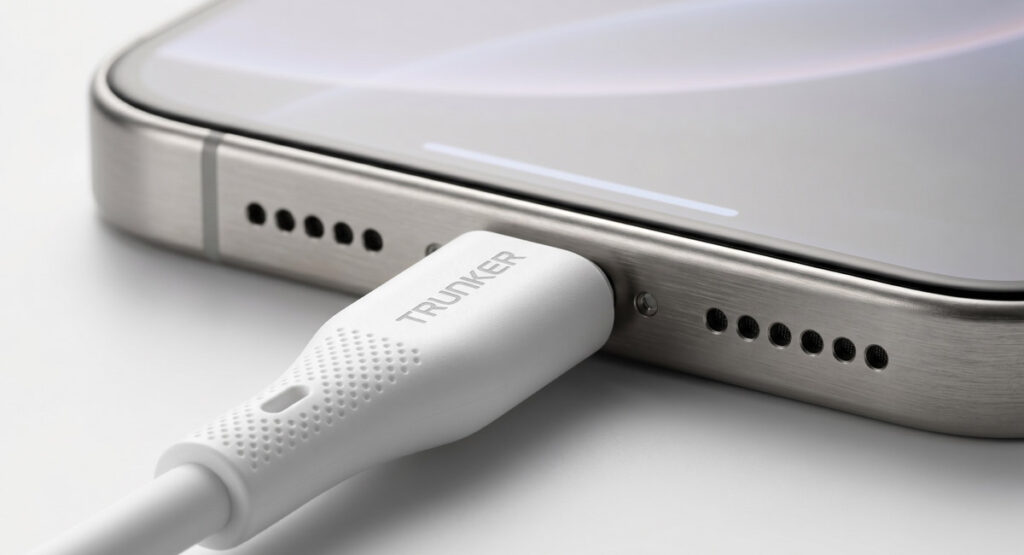
When you plug your fast charger into your smartphone, something remarkable happens—but it’s probably not what you imagine for the smartphone fast charging process. Many people assume the charger simply pumps maximum power into the battery until it’s full. The reality is far more sophisticated.
Fast charging is actually a smart, dynamic relay race between your phone and the charger. The entire process is carefully orchestrated to balance two competing goals: maximum charging speed and long-term battery health. The current and voltage don’t stay constant—they adjust continuously based on the battery’s real-time state.
We’ll walk through the complete fast charging journey, from the moment you connect the cable to the final trickle charge, explaining exactly why current changes at each stage.
Phase 1: Protocol Handshake (Communication)
The moment you plug in the cable, your smartphone and charger don’t immediately deliver power. Instead, they first establish a digital conversation through the USB-C data lines (specifically, the CC pins for USB-PD or D+/D- for legacy protocols like Qualcomm Quick Charge).
During this handshake, they negotiate:
- Which fast charging protocol to use (USB Power Delivery, Quick Charge, SuperVOOC, etc.)
- The optimal voltage and current combination
This step is critical. Without a successful handshake, the charger falls back to the standard USB 5V output—no fast charging occurs. The negotiation typically takes less than a second, but it sets the foundation for everything that follows.
Phase 2: Pre-Charging (Trickle Start)
If your battery is extremely depleted—typically below 3.5V—the charging process begins with a cautious small current, usually between 200mA and 500mA.
Why such a low current? Lithium-ion batteries are fragile when deeply discharged. Applying a high current at this stage could cause instability, generate excess heat, or even damage the internal electrode structure. Think of it as waking a sleeping person gently rather than shaking them violently.
This pre-charging phase uses a switching charging chip and continues until the battery voltage rises to a safe threshold (usually around 3.5V). Once that happens, the real fast charging can begin.
Phase 3: Constant Current Charging (The Fast Charge Begins)
Once the battery voltage is safely above the threshold, the charger enters constant current (CC) mode. Here, the charging current is fixed at a relatively high value—typically 2A to 4A depending on the charger and phone capability—while the battery voltage gradually increases.
This is where most of the energy flows into the battery. The power delivered during this phase can be significant, often reaching 15W to 30W or more. However, as the battery voltage rises, the charger continues to hold the current steady until the voltage approaches its upper limit (around 4.2V to 4.4V for modern lithium-ion cells).
Phase 4: Charge Pump Direct Charging (The Peak Power Zone)
When your battery reaches approximately 10% to 80% capacity, many modern fast charging systems switch to a more efficient architecture known as charge pump charging.
Here’s the magic: a charge pump can divide voltage and multiply current with near 100% efficiency. For example, if the charger delivers 8V at 4A (32W), the charge pump converts it to 4V at 8A (still 32W) directly into the battery. This bypasses the traditional switching charger, reducing heat generation inside the phone.
This is where you’ll see the highest current values—often 6A, 8A, or even 10A on systems like OPPO’s SuperVOOC or OnePlus’s Warp Charge. The charging speed is at its peak, and this is typically the phase that manufacturers highlight in their marketing.
However, this peak doesn’t last forever. It usually persists for only minutes to about 15–20 minutes, after which the current begins to taper.
Phase 5: Constant Voltage Charging (The Taper)
Once the battery reaches roughly 80% capacity, the charging strategy shifts dramatically. The charger now switches to constant voltage (CV) mode, where the voltage is capped at the battery’s maximum allowed level, and the current begins to decrease gradually.
Why? As the battery fills, its internal resistance increases. If the charger continued to pump in the same high current, the battery would overheat, and the excess energy would be wasted as heat rather than stored. By reducing the current, the charger protects the battery while still topping it off.
During this phase, you might see the current drop from 6A down to 2A, then 1A, and eventually much lower. This is why the last 20% of charging often takes as long as the first 80% —it’s not a linear process.
Phase 6: Trickle Charge and Termination
When the battery approaches 98% to 100% , the charging current becomes extremely small—typically below 100mA. This is known as trickle charging.
At this stage, the charger supplies just enough current to maintain the battery at its full voltage without overcharging. Once the battery management system (BMS) detects that the current has dropped to a preset termination threshold (e.g., 50mA), it cuts off the charging entirely. The phone displays “100%,” but the BMS may allow minor top-ups as the battery self-discharges over time.
Visualizing the Current Pattern
To summarize the entire journey, the current follows a clear pattern:
Small → High (Peak) → Gradually Decreasing → Very Small
It forms a characteristic “hill” shape, with the peak occurring not at the start but in the middle phase of charging. The power peak—the highest wattage—usually appears during the charge pump phase, but it’s short-lived.
For example, even with a 70W charger, an iPhone 16 only maintains its 21W peak for about 16 minutes before stepping down. The total time to 100% often stretches to 2 hours—illustrating that fast charging is not about full capacity in minutes, but about getting a significant top-up quickly.
The Safety Mechanisms Behind It All
Why does the current change so dynamically? Battery safety.
Lithium-ion batteries are sensitive to overcurrent, especially at two vulnerable points:
- When nearly empty (high internal resistance)
- When nearly full (risk of lithium plating)
Lithium plating occurs when excess lithium ions deposit as metallic lithium on the anode surface instead of intercalating into the electrode structure. This reduces capacity, increases internal resistance, and in extreme cases, can lead to swelling or thermal runaway.
The phone’s Battery Management System (BMS) constantly monitors voltage, current, and temperature. It communicates with the charger to adjust power levels in real time. This closed-loop feedback is what makes modern fast charging both safe and efficient.
Final Thoughts about Fast Charging Process
Fast charging isn’t a simple “full throttle until full” process. It’s a dynamic, multi-stage journey carefully designed to maximize speed while protecting your battery’s longevity. Understanding this process helps you appreciate why your phone slows down charging after 80%, why it might heat up more during the middle phase, and why your charger doesn’t always deliver its maximum rated power.
Next time you plug in, remember: behind that simple connection lies an intelligent conversation and a precision-tuned current profile—all working to keep your phone powered up and your battery healthy for years to come.
Lider is your ideal partner for custom cell phone accessories in China. We provides product design, packages design, manufacture, international shipping and more. Source phone chargers, USB cables, power banks, mobile covers and other mobile accessories from Lider now!