

In today’s modern life, the humble phone charger has become a constant companion, a silent enabler of our hyper-connected existence. We come home, plug in our smartphones, and often, once the device is detached and in our hands, the charger remains lodged in the wall socket, forgotten and idle until the next power crisis. This simple, seemingly harmless act of leaving a charger plugged in “just in case” is a habit shared by millions. However, this passive convenience comes with a host of hidden consequences, ranging from a subtle drain on your wallet to significant environmental impact and even potential safety hazards. The correct way is to unplug your phone charger once it is idle.
This article delves deep into the multifaceted reasons why developing the habit of unplugging your phone charger—both the AC adapter from the wall and the USB cable from the phone once it’s fully charged—is a small act of discipline that yields substantial long-term benefits. We will explore the physics of “vampire energy,” the chemistry of battery degradation, the overlooked risks of electrical fires, and the cumulative financial and environmental costs of our collective forgetfulness. We’ll also navigate the nuanced reality of modern charging technology, distinguishing between genuine risks and outdated myths.
1. The Myth of Zero Consumption: Understanding Vampire Energy
Many people assume a charger plugged into a wall socket but not connected to a phone uses no electricity. After all, it appears to be doing nothing. In reality, the opposite is true. A plugged-in charger remains an active device. Inside its casing, the circuitry continues converting high-voltage AC from your wall to low-voltage DC—the process your phone requires for charging.
This conversion is never perfectly efficient. When idle, the charger enters standby mode, drawing a small amount of power known as “phantom load” or “vampire energy.” This keeps internal components like transformers and voltage regulators ready to spring into action the moment you connect your device.
While an individual idle charger consumes very little—typically 0.1 to 0.5 watts—this drain runs continuously. A single charger left plugged in all year might use 2–4 kilowatt-hours, costing only dimes. The real issue is scale. The average household contains multiple chargers: in bedrooms, living rooms, and home offices. Multiply that tiny draw by millions of homes, and the phantom load becomes a gigawatt-scale problem.
This unnecessary consumption increases demand on power grids, driving fossil fuel use and carbon emissions. Unplugging your charger is one of the simplest ways to combat this invisible waste.
2. The Heat Factor: Degradation of Components and Fire Risk
Electricity flowing through any circuit generates heat—an unavoidable physical reality. When actively charging a phone, much of this heat dissipates into the device itself. But when a charger sits idle in a wall socket, the small amount of vampire energy still produces heat, now trapped within the charger’s plastic housing.
This continuous low-level heat buildup gradually damages electronic components. According to experts, chargers left plugged in indefinitely generate ongoing heat that accelerates internal aging. Capacitors, transformers, and solder joints experience thermal stress over time, making the charger less efficient and shortening its useful life. A charger that feels perpetually warm is slowly degrading itself.
This degradation introduces genuine safety risks. As internal components weaken and insulation becomes brittle, the likelihood of electrical faults increases. A failing charger may short circuit, overheat dramatically, or even catch fire. These risks multiply with poor-quality or uncertified third-party chargers. Even reputable models aren’t immune to long-term heat exposure. By unplugging your charger when not in use, you allow it to cool completely, slowing deterioration and reducing potential fire hazards.
3. Protecting Your Smartphone’s Battery Health
This reason applies specifically to the period during charging. While the act of unplugging the phone charger after the phone is at 100% is the focus, understanding the charging cycle is crucial. Modern smartphones use lithium-ion batteries, which are sophisticated but have specific preferences.
The “Trickle Charge” Effect
When your phone hits 100%, the charger doesn’t simply shut off. Instead, it enters a “trickle charge” or “maintenance charge” mode. As the phone’s battery naturally self-discharges a tiny amount, the charger kicks back in to bring it back to 100% . This keeps the battery in a constant state of high voltage, which accelerates a chemical process that contributes to capacity loss. Samsung notes that modern smartphones are equipped with smart charging technology that halts the process once the battery reaches full capacity, with the charger only kicking in occasionally to “top off” the battery . However, this constant high-voltage stress can still contribute to the gradual loss of the battery’s maximum capacity over the long term
The 20-80% Rule
Lithium-ion batteries experience the most stress when they are at the extremes of their charge cycle: below 20% and above 80%. Experts recommend keeping your phone’s battery between 20% and 80% to extend the lithium battery’s lifespan . By unplugging your phone once it reaches a full charge, you immediately relieve the stress of that high-voltage state. The battery is allowed to settle into a more comfortable, lower-voltage state .
Smart Charging Features
Recognizing this, manufacturers have built solutions into their devices. Apple’s “Optimized Battery Charging” and Huawei’s “Smart Charge” mode learn your daily routine. They will charge your phone to 80% and then pause, only resuming charging to reach 100% right before you typically wake up . While these software-based mitigations are excellent, the most reliable and effective method to ensure optimal battery longevity is still the simplest one: don’t leave it plugged in longer than necessary.
4. The Financial Pinch: The Cumulative Cost of Convenience
While the individual cost of powering a single idle charger is negligible, the cumulative financial impact across a household and a lifetime is more significant than most people realize.
Assume a household has four chargers constantly plugged in: a USB-C charger in the bedroom, a standard USB charger in the kitchen, a fast charger in the living room, and a wireless charging pad in the home office. Let’s assume an average idle power draw of 0.25 watts per device.
Total continuous idle power: 4 chargers * 0.25W = 1 watt.
Hours in a year: 24 hours/day * 365 days = 8,760 hours.
Total energy wasted per year: 1 watt * 8,760 hours = 8,760 watt-hours, or 8.76 kWh.
The average cost of electricity in the US hovers around $0.16 per kWh.
Annual cost for idle chargers: 8.76 kWh * $0.16/kWh = $1.40.
A dollar-forty a year is trivial. But this is only for idle chargers. The far larger financial waste comes from the act of leaving the phone plugged in overnight. A phone charger brick pulling power to maintain a 100% charge for 6-8 hours every night consumes significantly more than an idle charger.
Now, expand this view to a lifetime. A typical adult will use smartphones for 50-60 years. The cost of that overnight “trickle charge” waste, combined with the cost of the idle chargers during the day, could easily amount to hundreds of dollars over a lifetime—money spent on electricity that was used to overcharge a device and degrade its battery. Furthermore, by degrading your battery faster, you may be forced to replace your phone or its battery sooner than necessary, a cost that can run into the hundreds or thousands of dollars. Unplugging is a free action that protects your investment.
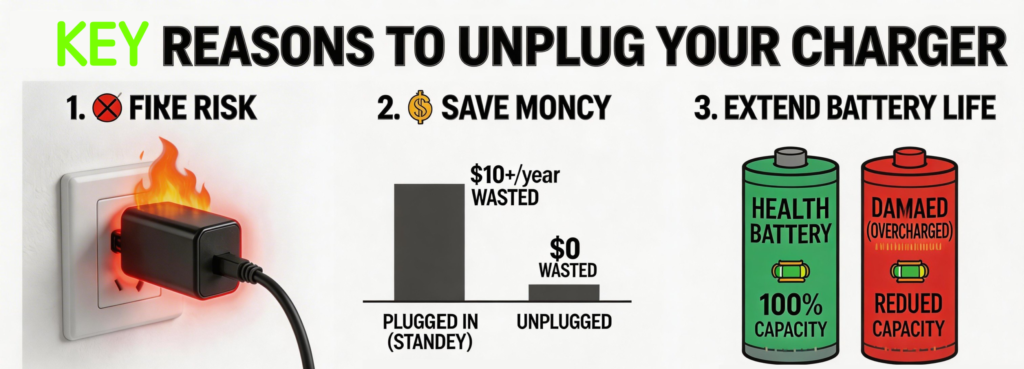
5. Safety Beyond the Charger: Fire and Household Hazards
There is a more immediate, tactile safety reason to unplug your phone chargers, especially for households with curious toddlers, playful pets, or during high-risk conditions like heatwaves.
Fire Brigade Warnings
The London Fire Brigade has issued clear warnings about charging habits. They state: “Batteries can present a fire risk when over-charged, short-circuited, submerged in water or if they are damaged. It’s really important to charge them safely too. Don’t leave items continuously on charge after the charge cycle is complete, it’s best not to leave your phone plugged in overnight for example. Never cover chargers or charging devices, that includes using your laptop power lead in bed” .
Heat Accumulation
Batteries generate heat while charging. If left unchecked, especially if covered by pillows or blankets, this can become a fire hazard . Laurie Pollard, managing director of Firechief Global, emphasized that phones generate heat during charging, and covering them with pillows or blankets can trap that heat, increasing the risk of overheating and potentially causing a fire .
Environmental Factors
During summer heatwaves, this risk is amplified. Charging your phone overnight in a hot environment can cause the battery to overheat more easily, posing a greater health and safety risk in your home . A Chinese science educator also advises charging in a ventilated and dry place, away from water sources and microwaves, and not using a computer’s USB interface to charge a phone because the power mismatch can easily damage the phone .
For Children and Pets
A dangling USB cable connected to a live wall socket is an irresistible temptation for a young child or a teething puppy. It can be yanked, pulled, and chewed on. While most modern USB ports output low voltage, the AC plug end is still firmly inserted into a live 110V/220V outlet. A child could potentially pull the charger partway out of the wall, exposing the live prongs, or cause damage to the outlet. To removes this hazard entirely, just unplug your phone charger.
6. Surge Protection: Shielding Your Devices from Power Fluctuations
A wall plug is a direct line to the electrical grid, which is not always a stable source of clean power. The grid is subject to “dirty power”—fluctuations, spikes, and surges caused by everything from lightning strikes to large appliances like refrigerators or air conditioners cycling on and off.
A power surge is a sudden, dramatic increase in voltage. If your phone is plugged in during a surge, the excess electricity can travel through the charger and directly into your phone’s delicate internal circuitry, potentially frying the battery, the charging port, or the main logic board. Even if your phone isn’t attached, the charger itself is still connected to the grid. A powerful surge can destroy the internal components of the charger, rendering it useless or creating a hazardous internal short circuit .
Huawei’s technical documentation highlights the importance of surge protection, noting that a surge is an instantaneous over-voltage beyond normal working voltage, a transient and violent pulse that can be generated in about one millionth of a second . It can cause data loss, performance degradation, shortened battery life, screen flickering, noise, circuit damage, and other issues .
While a high-quality surge protector power strip is the best defense against this, simply unplugging your charger when it’s not in use is a foolproof method of physical isolation. By disconnecting the charger, you break the circuit and guarantee that no power surge can reach your device through that path.
7. The Nuance: What Modern Phones and Chargers Actually Do
It’s important to acknowledge that technology has evolved. Many of the fears around overcharging stem from older battery technologies like nickel-cadmium, which suffered from “memory effect.” Today’s lithium-ion batteries and smart charging circuits are far more advanced.
Manufacturer Statements
Apple notes that “iPhone automatically stops charging when the battery is fully charged, so it’s safe to keep your iPhone connected to a charger overnight. When possible, unplug your iPhone after it has fully charged” . They also highlight that a battery warms up as it charges, which can reduce its lifespan, so they gradually reduce the charging current as the battery approaches full charge to reduce the effect of heat and prevent overheating .
Samsung confirms that “Modern smartphones are equipped with smart charging technology that halts the charging process once the battery reaches full capacity. The charger only kicks in occasionally to top off the battery, maintaining it at 100%. These are called ‘maintenance charges’, and they ensure that your battery remains full until you unplug your phone” .
The Balanced View
Tech experts agree that you don’t need to “baby” your battery. One expert commented on a forum discussion: “It doesn’t overcharge, and you don’t need to baby it. Just plug it in when you feel like it and leave it plugged in as long as you want, the charging controller will take care of the battery” . Another added: “Modern phones & chargers are smart enough to slow the charging down and then stop it as the battery gets full, so you don’t have to worry about it at all” .
However, while “overcharging” in the traditional sense (constantly pumping current into a full battery) is prevented, the state of being at 100% for extended periods, combined with the heat generated, still contributes to long-term battery degradation . So, while you won’t wake up to an exploded phone, you might wake up to a phone whose battery capacity has diminished faster than necessary after a year or two.
8. Environmental Responsibility: Reducing Your Carbon Pawprint
The environmental argument ties all the previous points together. The “vampire energy” wasted by idle chargers and inefficient overnight charging has to be generated somewhere. For the majority of the world, that energy comes from power plants that burn coal, natural gas, or other fossil fuels. This process releases carbon dioxide (CO2) and other greenhouse gases into the atmosphere, directly contributing to climate change .
Using our previous calculation of 8.76 kWh wasted annually by a household’s idle chargers, we can estimate the carbon footprint. The average CO2 emissions per kWh in the US is roughly 0.85 pounds (this varies significantly by regional energy mix). Therefore, that 8.76 kWh of wasted energy is responsible for approximately 7.4 pounds of CO2 emissions per year, per household.
Again, this seems small. But scale it up. There are over 120 million households in the US alone. If every household wasted just 8.76 kWh a year on idle chargers, the total national waste would be over 1 billion kWh. This would result in nearly 900 million pounds of CO2 being pumped into the atmosphere for absolutely no reason.
This doesn’t even account for the environmental cost of manufacturing and disposing of the chargers themselves. A charger that burns out prematurely due to constant heat stress becomes electronic waste (e-waste) , the fastest-growing waste stream in the world. By unplugging your phone charger, you extend its life, reduce the demand for new chargers, and lessen the burden on our planet’s landfills . It is a simple act of environmental stewardship.
9. Best Practices for Charger Longevity and Safety
Unplugging is the first and most important step, but here are a few complementary practices to maximize safety and efficiency:
The Correct Order Matters
Huawei recommends plugging the charger, then connecting the phone. This prevents a large impulse (surge) from damaging the phone during the moment of connection. When charging is complete, disconnect the phone first, then unplug your phone charger from the wall, to avoid reverse instantaneous current that could shorten battery life .
Inspect Your Chargers Regularly
Look for frayed cables, bent prongs, a cracked casing on the power adapter, or any signs of overheating (like discoloration). If you see any damage, replace the charger immediately.
Use the Right Charger
Always use the charger that came with your phone or a high-quality, certified replacement from a reputable brand. Cheap, uncertified chargers often lack proper safety features and can be a serious fire hazard .
Choose GaN Technology
Look for chargers that use GaN (Gallium Nitride) technology. GaN is a more advanced semiconductor material than traditional silicon. It’s far more energy-efficient, which means less electricity is wasted as heat during the charging process, and GaN chargers can be made much smaller .
Keep Chargers Ventilated
Avoid placing chargers under pillows, blankets, or in confined spaces where heat can build up. They need airflow to stay cool. Charge devices on clear, level surfaces well away from combustible items .
Unplug During Storms
If you know a thunderstorm is approaching, unplug your phone charger and other sensitive electronics as a precaution against power surges caused by lightning.
Don’t Let It Die Enable Smart Charging Features
On iPhones (iPhone 15 and later), go to Settings > Battery > Charging to set a charge limit between 80% and 100% . On Huawei devices, enable “Smart Charge” in Settings > Battery > More battery settings . These features use AI to learn your habits and prevent the battery from staying at 100% for too long.
Don’t Let It Die Completely
Avoid letting your phone’s battery drain completely to 0%, as this can reduce battery life. Start charging when it drops below 20% .
Clean the Charging Port
Gently clean the iPhone charging connector or Android port using a small, non-metallic, soft-bristled brush to remove debris that could interfere with charging .
Conclusion
In a world filled with complex problems, the act of unplugging a phone charger is a surprisingly simple solution with a wide range of benefits. It is a conscious decision to stop wasting energy, to save a small amount of money, to protect the health of your expensive devices, to reduce the risk of fire, and to contribute to a healthier planet .
The convenience of leaving a charger perpetually plugged in is an illusion, masking a host of hidden costs. While modern smartphones and chargers are equipped with smart technology to prevent catastrophic overcharging, they are not immune to the long-term effects of heat, high-voltage stress, and the constant, silent drain of vampire energy .
By adopting the simple, mindful habit of reaching for the plug once your phone is freed— unplug your phone charger from the wall—you transform from a passive consumer of energy into an active participant in a more efficient, safe, and sustainable lifestyle. So, the next time you pick up your fully charged phone, take that extra second. Unplug your phone charger. Your wallet, your devices, and the planet will thank you.