
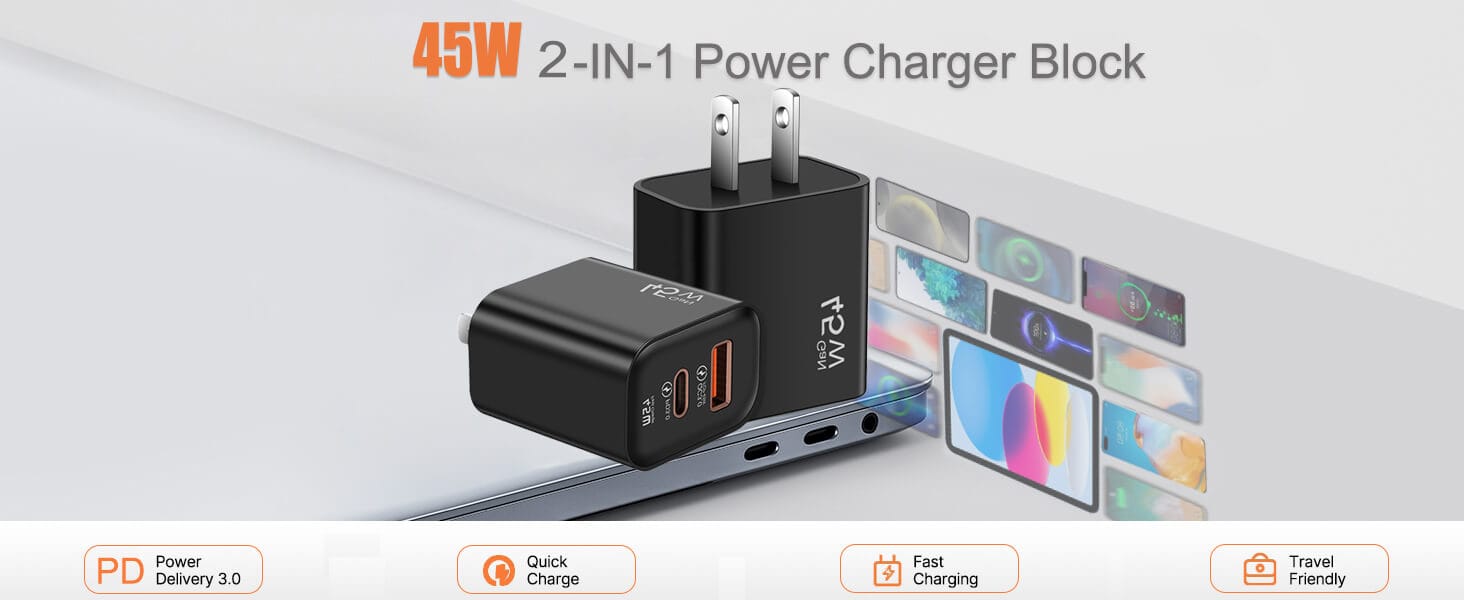
What is GaN, and why is it better than a regular charger?
GaN is a new semiconductor material that is more efficient than traditional silicon. Benefits include:
Smaller Size & Lighter Weight: A 65W GaN charger can be half the size of an old 65W silicon charger.
Cooler Operation: Generates less wasted heat.
Higher Efficiency: Often leads to better power density and can support more advanced features in a compact form.
Is a GaN charger worth the extra cost?
Yes, for most people seeking portability. If you value a smaller, lighter charger for your bag, travel, or desk, GaN is a significant upgrade. If you just need a cheap, basic charger to leave plugged in at home, a standard charger may suffice.
Do GaN chargers charge faster?
Not directly. The speed is determined by the wattage and protocols, not the GaN material itself. However, because GaN allows manufacturers to pack higher wattage into smaller bricks (e.g., a tiny 140W charger), you are more likely to buy a powerful, fast-charging charger in a portable size.
Does my charging cable matter?
The phone charging cable play very important role in charging. It connects phone / tablet / laptop and the GaN charger. For example, we use the 100W GaN charger to charge 65W Macbook Pro with a max charging cable of 30W USB cable. The power Watts is only 30W. It is the lowest part that defines the charging speed.
Why I cannot use GaN chargers for my home gadgets, such as electronic tooth brush?
Using USB fast chargers (such as 18W, 65W, or even 100W+ PD/QC protocol GaN chargers) to charge low-current devices like electric toothbrushes is technically possible but carries risks.
How Fast Charging Works: Fast chargers communicate with devices via smart protocols (e.g., PD, QC) to negotiate the appropriate voltage (e.g., 5V/9V/12V) and current. However, low-current devices like electric toothbrushes typically only support traditional 5V/1A (or lower) input and lack fast-charging protocol chips.
Protocol Negotiation Failure: If the device cannot respond to the fast-charging protocol, some chargers may default to 5V base voltage, which might still charge the device. However, certain fast-charging adapters may output unstable voltage (e.g., voltage fluctuations) due to protocol mismatch, potentially damaging the device’s battery or circuitry over time.
Devices like electric toothbrushes often use NiMH batteries or small lithium batteries with simple charging management chips and weak overcurrent protection.
Is 25W GaN charger better than 45W charger?
That’s a great follow-up question. The short answer: No, a 25W GaN charger is not “better” than a 45W charger if your device needs more than 25W of power. However, the comparison isn’t just about wattage—it depends on what you’re charging and how you value size versus speed.
Let’s break it down clearly.
Wattage Is the Primary Factor
A 45W charger (whether GaN or traditional silicon) delivers nearly twice the power of a 25W GaN charger. For a laptop, tablet, or fast-charging smartphone that supports 45W Power Delivery (PD), the 45W charger will charge significantly faster. For example:
A 45W charger can fully power a MacBook Air or charge an iPad Pro at full speed.
A 25W GaN charger will struggle to keep a laptop alive during use and may only trickle-charge it.
If your device requires 30W or more, the 45W charger is objectively better, even if it uses older silicon technology.
Where a 25W GaN Charger Wins
A 25W GaN charger excels in specific use cases:
Size & portability – It can be tiny (like a cube or even smaller than an Apple’s 5W brick) while delivering 25W. Ideal for iPhones (which max out around 27W), AirPods, or smartwatches.
Heat efficiency – GaN’s advantage means a 25W GaN charger runs cooler and is safer for overnight charging compared to a bulky, hot 45W silicon charger.
Cost – Generally cheaper than high-wattage GaN units.
The Best of Both Worlds
If you need both compact size and high power, look for a 45W GaN charger – they exist and are only slightly larger than a 25W GaN model. A 45W GaN charger will outperform any 25W charger (GaN or silicon) while still being smaller than a traditional 45W silicon brick.
Final Verdict
For a smartphone or small device → 25W GaN is fine, but a 45W charger won’t harm it (devices only draw what they need).
For a laptop, tablet, or multiple devices → Always choose higher wattage. A 45W charger (even silicon) is better than a 25W GaN charger.
Key takeaway: GaN improves efficiency and size, but wattage rules charging speed. Don’t trade power for technology – match the charger’s wattage to your device’s needs first, then prefer GaN for the same wattage.