
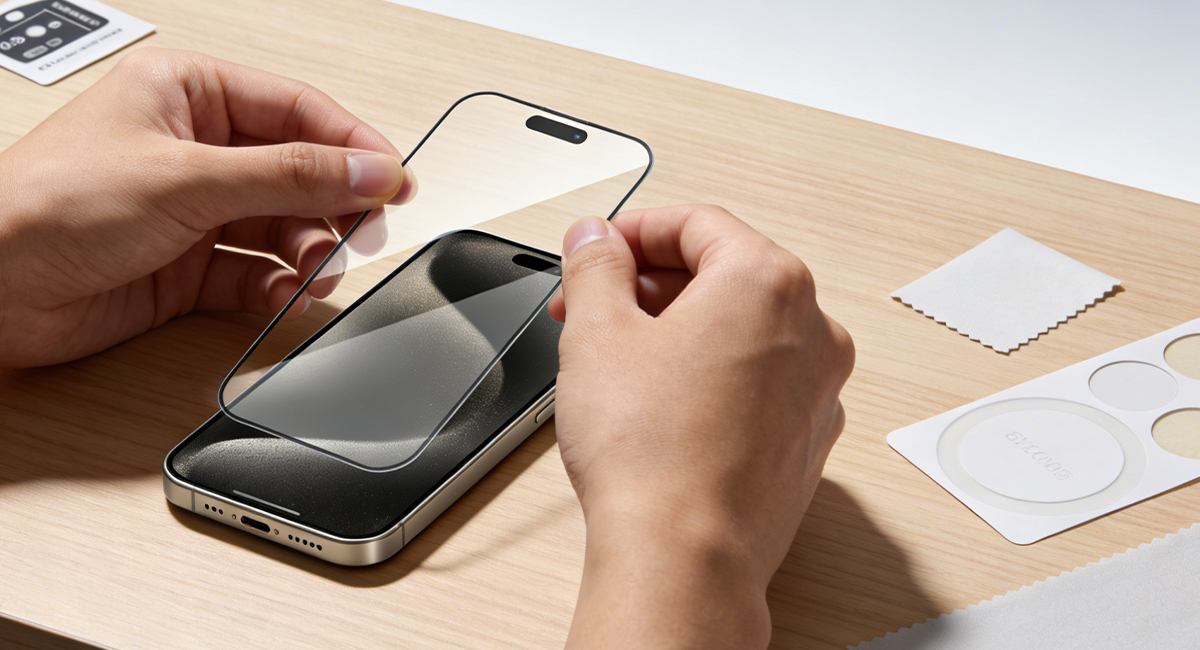
In the world of mobile accessories, a screen protector is no longer just a simple piece of plastic. It is a sophisticated piece of engineering designed to preserve the clarity, responsiveness, and structural integrity of your device’s most important asset: the display. With the rise of foldable phones, curved edge displays, and advanced biometric security, the terminology surrounding screen protectors has become increasingly complex.
If you have ever been confused by terms like “high-aluminum,” “silk-screen printing,” or “anti-static coatings,” you are not alone. As a screen protector manufacturer in China, we will break down every modern screen protector specification—from the shape of the glass to the chemical composition—to help you understand exactly what you are buying and why it matters.
1. The Evolution of Form Factors
O-Shape and Octagonal Designs
Gone are the days when all screen protectors were simple rectangles. Modern protectors often feature unique geometries to accommodate the specific design languages of smartphones.
- O-Shape Foldable: This refers to protectors designed for foldable devices. The “O-shape” often describes the cutout or the unique folding mechanism that allows the glass to bend without cracking. These protectors require a special polymer layer to maintain structural integrity during repeated folding.
- Octagonal (8-Sided): As smartphone bezels shrink, manufacturers are moving away from harsh right-angle corners. Octagonal protectors feature beveled edges that follow the natural contours of the device chassis. This reduces the “sharp” feeling on the fingers and minimizes the risk of the protector snagging on pocket fabric.
Full-Screen Silk-Screen
When you see a protector labeled “Full-Screen Silk-Screen,” it refers to the border around the edge of the glass.
- The Process: Silk-screen printing is used to apply a colored border (usually black or white) to the perimeter of the tempered glass.
- The Purpose: This border serves two functions. Aesthetically, it seamlessly blends with the phone’s bezel. Functionally, it hides the adhesive layer and the “dot matrix” (the tiny dots that prevent rainbow effects on non-OLED screens), ensuring that the protector adheres perfectly to the screen without lifting at the edges.
2. Material Science: Aluminum Content and Hardness
The quality of tempered glass is determined by its manufacturing process and material composition. The term “aluminum” in this context refers to aluminosilicate glass, a type of glass strengthened by ion exchange.
High-Aluminum vs. Medium-Aluminum
- High-Aluminum Tempered Glass: This is the premium standard. High-alumina glass has a higher concentration of aluminum oxide, resulting in a tighter molecular structure. It is significantly harder to break and more resistant to scratches. When combined with a “Large Curve” (大弧) , high-aluminum glass provides a seamless edge that feels exactly like the original phone screen, making it ideal for curved displays.
- Medium-Aluminum Tempered Glass: This is a cost-effective alternative. While it still offers decent impact resistance, medium-aluminum glass is typically used for “Flat Screen” devices. It provides adequate protection for standard non-curved displays but may lack the structural rigidity needed for the stress points found on curved or foldable screens.
The “White Sheet” (白片) Standard
In manufacturing, a “White Sheet” (Clear) protector refers to a unit without a colored border. These are typically made from higher-grade raw glass because there is no silk-printed border to hide impurities or slight imperfections. If you prioritize optical clarity over aesthetics, a clear high-aluminum protector is often the superior choice.
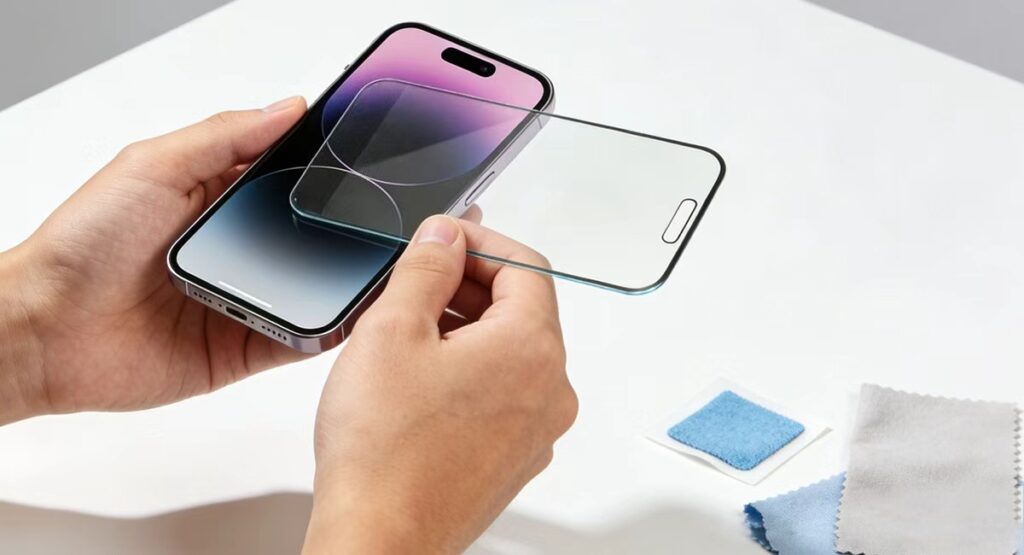
3. Functional Coatings: Beyond the Glass
The physical glass is only half the story. The coatings applied to the surface determine the user experience.
Oleophobic Coating (涂油)
Often listed simply as “Oleophobic,” this is the oil-repellent layer applied to the surface of the glass.
- Function: It prevents fingerprint smudges from sticking to the screen.
- Quality Indicator: A high-quality “coated” protector uses an electroplating process that fuses the oleophobic layer to the glass at a molecular level, lasting for months. Cheaper protectors use a spray-on coating that wears off in weeks.
Anti-Static (防静电)
Electrostatic discharge (ESD) is a silent enemy of electronics.
- The Problem: Standard screen protectors can generate static electricity, which attracts dust particles during installation (causing bubbles) and can, in rare cases, interfere with touch sensitivity or attract dirt to the speaker grille.
- The Solution: Anti-Static technology uses a layer that dissipates static charge. This ensures a dust-free installation and keeps the screen cleaner for longer by repelling airborne particles rather than attracting them.
Glow in the Dark (夜光)
A niche but popular aesthetic feature, Glow-in-the-Dark (Luminous) protectors use photoluminescent pigments in the border or the glass itself. After exposure to light, they emit a soft glow in dark environments, making it easier to locate your phone on a nightstand or adding a stylistic flair.
4. Precision Engineering: Cutting and Installation
How the glass is cut affects both the installation process and the functionality of the phone’s features.
Precision-Cut Camera (精雕)
One of the most critical aspects of modern screen protectors is the camera cutout.
- Precision-Cut: Using CNC (Computer Numerical Control) machinery, manufacturers can carve out exact spaces for the front camera and sensors. A poorly cut protector can cause camera haze (blurriness) or interfere with the proximity sensor, causing the screen to turn off during calls.
- Match the Camera: High-end protectors now often utilize a “precision-cut camera edition,” where the hole for the camera is perfectly aligned to avoid dust accumulation while ensuring zero interference with photo quality.
Dust Mesh (防尘网)
Located typically at the top of the protector (the earpiece area), the Dust Mesh is a small, fine grid.
- Function: It acts as a physical barrier, preventing dust, lint, and pocket debris from clogging the phone’s actual earpiece speaker.
- Integration: When combined with Anti-Static properties, the dust mesh ensures that the speaker remains clean without relying on static cling to hold particles, which often leads to permanent staining.
Fingerprint Unlock Compatibility (指纹解锁版)
With the prevalence of under-display fingerprint scanners (ultrasonic or optical), glass thickness has become a major issue.
- The Challenge: Standard thick tempered glass can block the ultrasonic waves or optical light needed for the fingerprint sensor to read your print.
- The Solution: Protectors labeled “Fingerprint Unlock Version” are typically Ultra-Thin (ranging from 0.1mm to 0.2mm) and feature a specialized adhesive layer that allows the biometric signal to pass through without degradation. If a protector is not specifically marked for fingerprint compatibility, you may find yourself entering your passcode frequently due to sensor failure.
5. Structural Integrity: The Arc and the Edge
Large Curve (大弧) vs. Flat (直面)
The edge profile of a screen protector determines its longevity and feel.
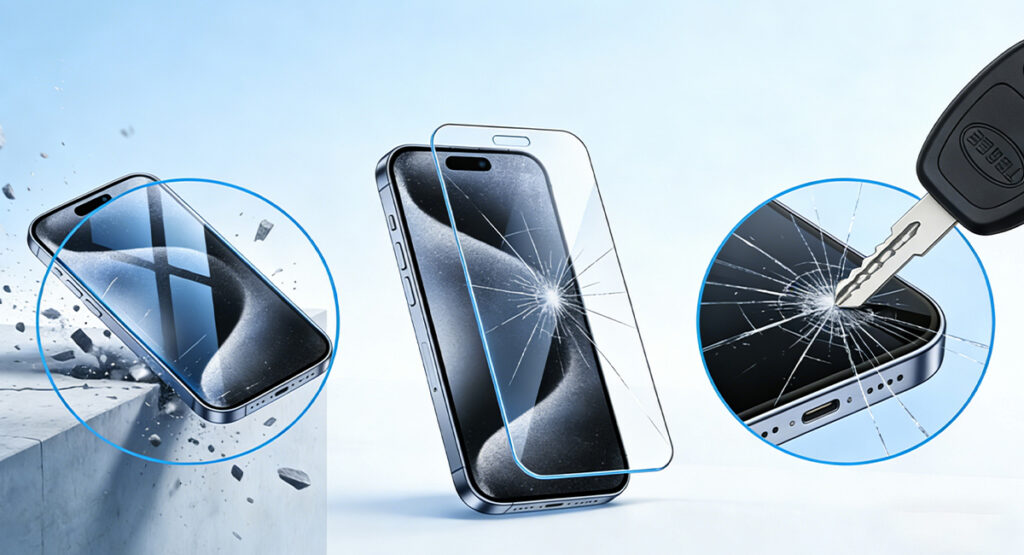
- Large Curve (Big Arc): This design features a rounded, polished edge that wraps around the curvature of the phone screen. It is essential for “waterfall” or 2.5D/3D curved screens. The large arc eliminates the “step” between the glass and the phone frame, preventing the protector from chipping when the phone is dropped.
- Flat (Straight Face): A flat protector is a straight piece of glass with beveled edges. This is best for iPhones (pre-iPhone 12/13/14/15/16 series that use flat edges) or older Android models with completely flat LCD screens.
6. The Ultimate Product Specification
When looking for the highest tier of protection, you will often encounter a product description that combines all the elements we have discussed. For example, a premium protector might be listed as:
“Octagonal High-Aluminum Tempered Glass | Large Curve | Full-Coverage Silk-Screen | Anti-Static & Oleophobic Coating | Precision-Cut Camera & Dust Mesh | Fingerprint Unlock Compatible”
Here is what that means in plain English:
- Octagonal: It is shaped to fit the phone’s rounded body without sharp corners.
- High-Aluminum / Large Curve: It is made from the strongest glass available and is shaped to wrap around curved edges smoothly.
- Full-Coverage Silk-Screen: It has a printed border to cover the edges and prevent dust from seeping under the sides.
- Anti-Static: It won’t attract dust during installation.
- Oleophobic: It resists fingerprint smudges.
- Precision-Cut: The camera hole is perfectly aligned.
- Dust Mesh: The speaker is protected from debris.
- Fingerprint Compatible: It is thin enough to work with under-display sensors.
Conclusion
Choosing the right screen protector is about more than just preventing scratches; it is about maintaining the functionality of your device. Whether you are looking for an O-Shape Foldable protector for your new flip phone, a High-Aluminum option for a curved flagship, or a simple Medium-Aluminum Flat protector for a budget device, understanding the language of screen protectors empowers you to make the right choice.
Invest in the specifications that match your lifestyle. If you hate fingerprints, prioritize Oleophobic Coating. If you live in a dusty environment, the Dust Mesh and Anti-Static features are non-negotiable. And if you rely on your fingerprint to unlock your phone, always ensure you opt for the Fingerprint Unlock Compatible version. Your screen is the window to your digital life—protect it with the right technology.
Need a solution for your phone screen protector business or custom mobile accessories? Contact Lider immediately to learn more.